

Strategic Planning Task Forces Convene to Compare Notes
As the church year settles into a series of low summer Sundays, four dozen lay leaders and clergy from throughout the Episcopal Diocese of Chicago are busily developing a series of recommendations for the diocese’s short-term future.
Four Strategic Planning Task Forces were launched in late March, each to pursue one of four key priorities:
- Build a sustainable future for diocesan ministry
- Support clergy and laity in deepening faith and relationships
- Strengthen and sustain healthy congregations
- Encourage social outreach and prophetic witness
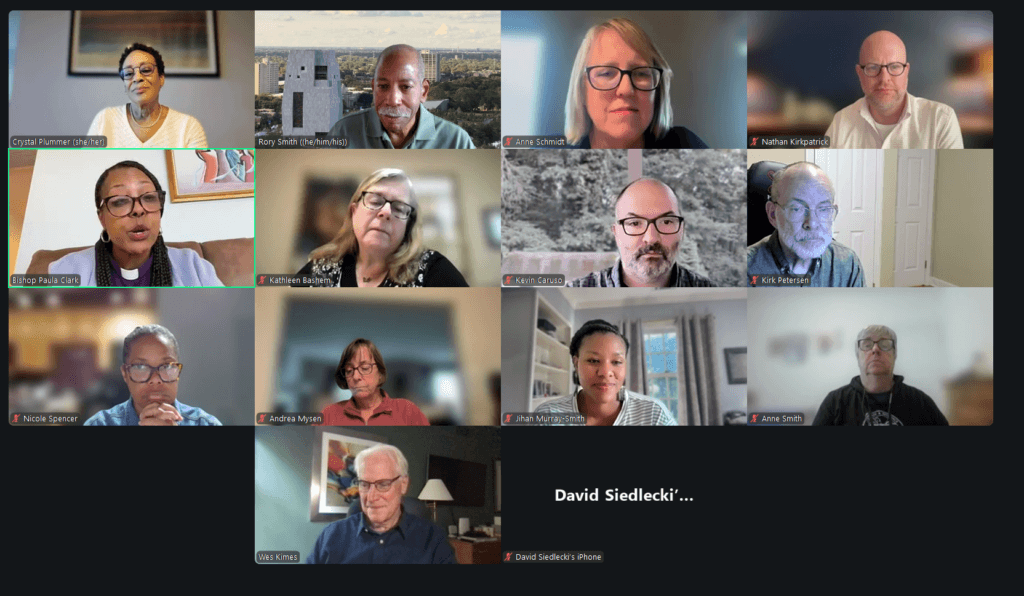
The co-chairs and staff liaisons of the task forces held a check-in meeting online June 25. Each task force has been asked to develop two to three specific recommendations to present at the 189th Diocesan Convention in November. The recommendations are to address the short-term needs of the diocese.
There is “an eagerness and commitment to getting in the weeds” in examining the needs of the diocese, said Nicole Spencer, co-chair of the Sustainable Future task force and a former warden at St. James Cathedral in Chicago. “We are also learning that things are even more complex and nuanced than we ever thought going in. And we were not, I think, naive.”
She and her fellow task force members are examining three major aspects of sustainability: financial stability and resource stewardship; governance, transparency and equity; and congregational vitality and capacity building.
The Deepening Faith task force also has three themes: “enhancing what exists; truth telling and restoration; and formation opportunities for both clergy and lay folk,” said the Rev. Jihan Murray-Smith, co-chair of the task force and senior associate rector at Church of the Holy Spirit in Lake Forest.
She reported that “the group is kind of split,” with some members focused on generating ideas, while others “feel like we need to continue to address the deep wounds, the hurts, the grief, the neglect,” identified in the survey of the diocese.
“What is a vital congregation?” The Congregational Health and Vitality task force has been struggling to answer that question, said the Rev. Kevin Caruso, rector at Trinity in Wheaton. Answers have ranged from “very specific and tactical things” such as finding someone to fix the roof, to “best practices around how do you deal with stewardship, to some pretty profound spiritual needs around access to the Eucharist.”
He added, “we are pressing forward and have a lot of energy for it, but also feel a lot of pressure” because of the schedule.
The Social Outreach and Prophetic Witness task force, similar to Deepening Faith, had to reconcile different approaches among subgroups. “Some folks were very much ready to say, okay, what is it we’re gonna do, and I’m gonna go do it!” said the Rev. Anne Smith, deacon at Annunciation in Gurnee. “And others were comfortable with, let’s dream, let’s think about what’s in our hearts first, let’s listen to each other’s voices.”
Financial considerations ran through much of the deliberations, “especially as we’re talking with people with lots of different ways of being church, from lay-led congregations to ones that are much more resourced,” Caruso said.
Multiple participants said their task forces had identified the various deaneries as an underutilized resource. The 112 congregations of the diocese are organized into 10 geographic deaneries. Each deanery elects an ordained and a lay representative to Diocesan Council. The congregations in each deanery are encouraged to develop ways to share information and activities, and some are more active than others. Click here to see which churches belong to which deaneries.
Task force leaders were told that if their recommendations have budgetary implications or would require a resolution of Diocesan Convention, they need to be aware of certain deadlines. Final budget requests are due by August 5, and resolutions are due September 11. The convention will again be a two-day, hybrid event, with an online session on Tuesday, November 10 at 6:30 pm, and an in-person session November 14 at the Cliffbreakers Event Center in Rockford, from 9 am to 4:30 pm.
Wes Kimes, a member of the diocesan Standing Committee and vestry member at St. Michael’s in Barrington, is not a task force member, but was one of the driving forces behind the strategic planning process. “This diocese now is moving its collective soul towards a better place, and I just am totally grateful for all the work that you have done,” he told the group.
Bishop Paula Clark closed the meeting with a prayer that served also as an acknowledgement of the work of the task forces. “The energy is flowing, the commitment is evident, and we are so grateful for the awesome work that’s being done. We ask you, oh God, to be with us this day, and as we face some of the difficult timelines that affect us, let us know that you’re always guiding us in the opportunity to be all that you’re calling us to be.”
Amen.
Questions and ideas about the strategic planning process can be directed to Crystal Plummer, canon for networking.