

New Life in a Resurrected Body
Celebrating ten years of reunion between Quincy and Chicago
Driving past St. Paul’s Church on Peoria’s War Memorial Drive, it doesn’t seem like the church has changed much in the last decade. The striking mid-century modern building with a stark stone spire still towers above its surroundings on the prairie landscape of southern Illinois, and its massive stained-glass depiction of the conversion of St. Paul—known to members as “Tall Paul”—looks just as it did when it was completed in 1959.
The first sign of the sea change that has swept over the congregation since 2008 comes when a visitor gets closer and sees the Pride and Black Lives Matter banners in the long yard along the road. And recently, a sign inside the building literally stopped the Rev. Gay Clark Jennings in her tracks. It was a poster on the door of the room announcing it as the Peoria Youth Drop-In Center for LGBTQ+ youth.
These markers of inclusion are routine in many Episcopal churches, but at St. Paul’s, which, until 2013, was the cathedral of the once arch-conservative Diocese of Quincy, they were hard-won. In 2003, the diocese’s bishop, Keith Ackerman, helped lead resistance to the consent of Gene Robinson, the Episcopal Church’s first openly gay partnered bishop. Women could not be ordained to the priesthood in Quincy, and in 2006, shortly after the election of Presiding Bishop Katharine Jefferts Schori, the diocesan convention passed a resolution saying that it was “unwilling to accept the leadership” of the church’s new leader.
“It is difficult to explain to people who didn’t live through it how far the Episcopal Church in this part of Illinois has come,” Jennings, president of the church’s House of Deputies from 2012 to 2022, said. “I give thanks to God for the strength and perseverance of the faithful Episcopalians who made it possible for all of God’s people to be welcome in the Episcopal Church in Peoria.”

Jennings and Jefferts Schori visited St. Paul’s on September 9 for a service celebrating the tenth anniversary of the reunion of the Diocese of Quincy and the Diocese of Chicago. Jefferts Schori, who served as presiding bishop from 2006 to 2015, preached at the service, at which Bishop Paula Clark presided and Bishop Jeffrey Lee, retired bishop of Chicago, led prayers.
Today, it is not uncommon for dioceses split in the nineteenth or twentieth century to consider reuniting to strengthen mission and streamline operations. But the Quincy-Chicago reunion, like the 2022 reunion of the Dioceses of North Texas and Texas, was the result of a crisis over the Episcopal Church’s move toward full inclusion of women and LGBTQ Christians.
After years of increasingly strained relations, in 2008, Ackerman and about 60 percent of the diocese’s clergy broke away to become founders of the conservative Anglican Church in North America. Like four other dioceses where conservative blocks departed the denomination, they attempted to take church property and funds with them.
“The people of the former Diocese of Quincy, together with the people of Ft. Worth, San Joaquin, Pittsburgh and South Carolina, may have lived through hell, but you have found new life in a resurrected body,” Jefferts Schori said in her sermon. “It may be called Chicago now, but as you and your neighbors keep seeking justice and loving neighbors as yourselves, we begin to see the city of God here on earth. We had a long and painful season as former Episcopalians departed. It was traumatic for many, many people, and it was befuddling when clergy left and told their parishioners to leave.”
Of the 22 churches in the Diocese of Quincy, 18 left the Episcopal Church, while Episcopalians in Macomb, Galesburg, Rock Island, and Moline established continuing Episcopal congregations in new locations. In 2004, the Diocese of Quincy had approximately 3,000 members; by 2008, the number had declined to 1,500.
Christine Barrow was raised at St. Paul’s but left for 30 years as she worked in other parts of the country and belonged to parishes in other Episcopal dioceses. She moved back to Peoria in 2000, not long before the strains in the diocese intensified. Shortly before the split, she served on the cathedral chapter and was the bishop’s warden.
The conflict, “felt very much like a family breaking apart,” she said. “The dysfunction was so palpable. People were confused—stunned—by the actual vehemence of community members.”
It was clear to Barrow that at St. Paul’s, the conflict was about the ordination of women. “This was long after it had already occurred elsewhere, but it was like we were an enclave of conservatism and it wasn’t going to touch us,” she said. “We had always had male priests, male-led everything. They were from a patriarchal mindset. How could you possibly think of taking communion or being blessed by anyone but a man?”
Michael Renner, a member of St. Paul’s since 1980, remembers that when the schism finally came, at least eighty percent of the then-cathedral’s congregation voted to stay in the Episcopal Church. Much of the credit, he said, is due to the Very Rev. Bob Dedmon, who served as dean from 2005 to 2014 and warned against departure, saying that “historically schism begets more schism.”
“He did remarkable things to keep the congregation together,” Renner, who was the Diocese of Quincy’s treasurer for several years in the early 2000s, recalled.
Barrow agreed. “I was on the search committee, and I truly believe that God placed him with us.”
While the departure of friends was painful, both Renner and Barrow describe the days immediately after the split as “coming from darkness into the light.”
“It was an immediately joyful place,” Renner said.
Along with several other loyal Episcopal leaders, he helped reorganize the diocese, traveling to meetings at the Episcopal Church headquarters in New York. In 2009, those efforts led to the creation of the Quincy Future Committee and the election of Bishop John Buchanan, the retired bishop of West Missouri, as bishop provisional.
“Bishop Buchanan was the right man at the right time,” Renner said. “His demeanor helped move everything forward.”
As the diocese reorganized, the Church Pension Group’s CREDO Institute provided retreats and support to its leaders. At the time, Jennings was CREDO’s associate director.
“The responsibility of leadership … fell to lay leaders and clergy,” she said in her sermon on the day after the reunion anniversary celebration, when she preached at St. Paul’s Sunday service. “These faithful Episcopalians demonstrated tremendous courage, vision, tenacity, and loyalty as they carried on by organizing people in existing congregations or new faith communities, establishing budgets, rebuilding diocesan infrastructure and administration, engaging in necessary litigation, and reunifying with the Diocese of Chicago—all while still proclaiming the gospel to a hurting and broken world.
“For the help and assistance given to you from the wider church, I am glad we could do that,” she said. “For what was not done or what was done poorly, I offer my deepest apology.”
The Rev. Peggy Lee, a long-time deacon who became the first woman ordained in the Diocese of Quincy in 2010, has painful memories of the remnant diocese’s early days.
Her ordination, according to Episcopal News Service’s interactive timeline of the history of women’s ordination, marked a denominational milestone: Quincy had been the last diocese in the church that refused to ordain women. But for Lee, who had hoped her ordination would be focused on her ministry, not on church politics, the occasion was bittersweet.
“Ordination is supposed to be joyful, but it was just painful,” she recalled. “The past was very painful, the split of the Diocese of Quincy was painful. Let’s face it, I still have a lot of friends in the other [ACNA] diocese.”
As Buchanan worked to knit what remained of the diocese to the rest of the Episcopal Church, the Quincy Future Committee was considering the diocese’s next steps. Options included remaining an independent diocese, merging with neighboring dioceses, or reuniting with the Diocese of Chicago. (The two dioceses were formed in 1877, when the Diocese of Illinois, founded in 1835, split to accommodate growth.)
In early 2012, the committee approached Chicago’s bishop, Jeffrey Lee, about the possibility of reunion. He appointed a group of leaders, called the Quincy Committee, to meet with the reorganizing diocese’s leaders. Later that year, Bishop Lee made the case for reunion to Chicago’s convention.
“I have seen first-hand how God’s people in Quincy long to be active participants in the future God has for us as a church,” he said. “Episcopalians have a role to play and a story to tell. I do not have all the answers to what that future might look like in all its details, but I do know I will not walk away from Episcopalians in the Diocese of Quincy who want to join with us in witnessing to the power of the Risen Christ who overcomes all divisions.”
Renner remembers his first encounters with Bishop Lee. “When he came to worship, he would fit in. He was very human—one of us.”
Valerie Renner, who is married to Michael Renner, recalls a vestry retreat during the reunion process that Bishop Lee and the Rev. Jim Steen, the Diocese of Chicago’s director of ministries, attended.
“We thought we needed to get rid of the building,” Valerie Renner, who now serves as one of St. Paul’s wardens, said. “Jeff and Jim helped us see that it is our biggest asset, in addition to our parishioners.”
On June 6, 2013, the conventions of the Diocese of Quincy and the Diocese of Chicago unanimously agreed to reunite. The consents of bishops and standing committees across the Episcopal Church were received over the summer, and on September 1, reunion took effect.
For Peggy Lee, reunion was a balm. “It was pretty painful until we joined the Diocese of Chicago and Bishop Lee and the people in Chicago took away a lot of the pain,” she said. “He made it about ministry and my call to be a priest, not about politics. And that was important. It has to be God’s choice.”
Less than two years later, St. Paul’s—now a parish church—called the Rev. Jenny Replogle and the Rev. Jonathan Thomas, a married couple, as co-rectors. The eight years since then have been good ones for the congregation, its leaders say.
“We have been growing, and that’s because of Jonathan and Jenny,” Barrow said. “They have been instrumental in helping us pull our act together.”
In addition to LGBTQ ministry, Replogle and Thomas have led the congregation to welcome more families with young children, like their own two sons, ages five and two, and people from a diverse cross section of the community. Thomas has helped repurpose much of the building’s 54,000 square feet into offices, studios, and gathering space that houses community partners, entrepreneurs, and local artists.
“We’re a fairly small church with some responsibility in a whole city,” he recently told Peoria Magazine. “What we really need to do is make sure that what we think is God’s work is happening in Peoria, and that we are in places where we can express what we think the good news is.”
“That is where the life of the church is,” Barrow agrees. “Whoever people are, we want to welcome them in.”
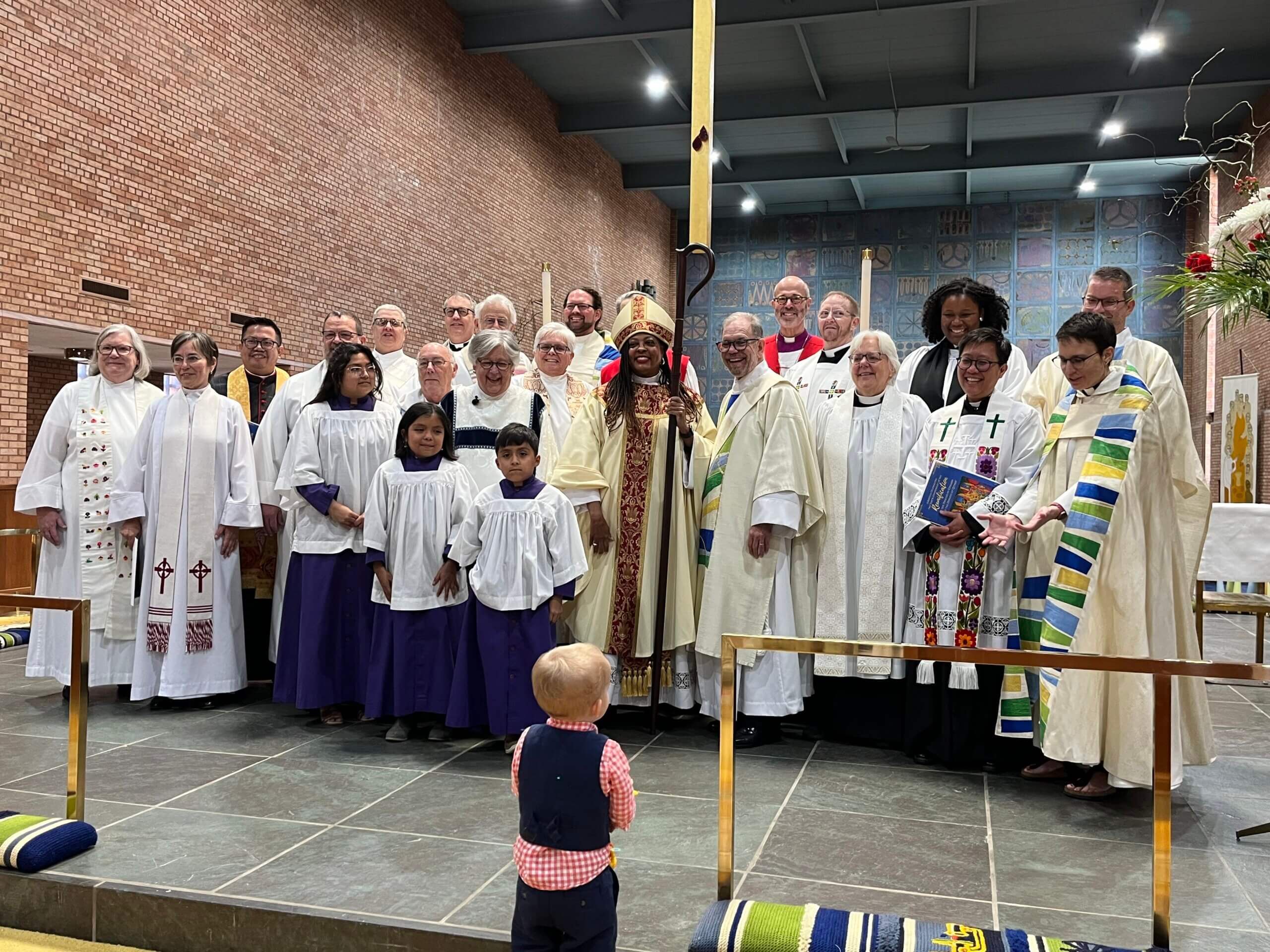
Toward the end of the reunion celebration, Replogle’s and Thomas’ younger son, Asher, made a break from the children’s soft space near the center of the vast nave and ran toward his mother, who was vested and seated up front with the visiting bishops and dignitaries. Scooping him up, she carried him back to her seat between Jefferts Schori and Jennings.
Together, the three women, not one of whom would not have been permitted to stand at the church’s altar only 15 years ago, finished leading the service that celebrated St. Paul’s and the entire the Diocese of Quincy walking from the darkness into the light.
***
Today, St. Paul’s is one of seven congregations in the Diocese of Chicago’s Peoria Deanery. Several of the others—St. James, Lewistown; Good Shepherd, Macomb; and All Saints, Rock Island—benefitted from the 2020 settlement of a lawsuit with the ACNA Diocese of Quincy, while Grace, Galesburg and All Saints, Rock Island benefitted from the settlement of similar suits in 2022 and earlier this year. St. John’s, Kewanee and St. Paul’s, Warsaw also continue in ministry and benefit from funds recovered in the settlement that are held in the Bishop’s Funds for the benefit of the entire Peoria Deanery.
St. James, Griggsville also benefitted from the 2020 settlement. Last year, the congregation’s few remaining members voted to close their parish and contribute its remaining funds to the Griggsville-Perry school system and feeding programs in Griggsville and Pike County.
image: Reunion anniversary service participants pose for a photo at St. Paul’s, Peoria, while Asher Replogle-Thomas looks on